
Beeple's 'Realistic Animals' has a lot to say about reproduced art
His Centaurian robot dogs sit and stay like good boys, but they still poop on the floor.

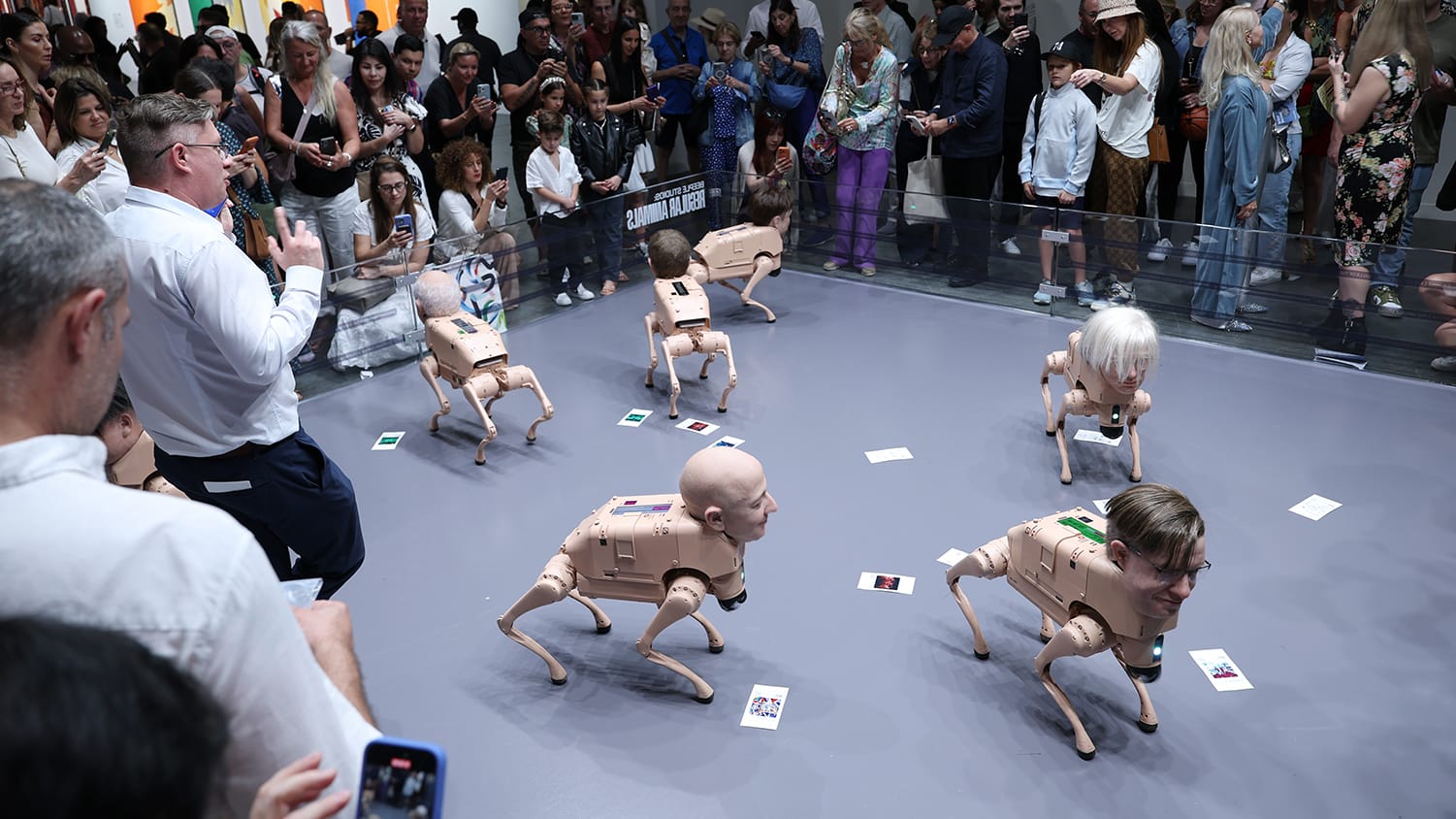
Beeple's Realistic Animals has the aura of a 19th-century freak show. At Art Basel's Zero 10 exhibition space in Miami, Florida, there's a bunch of robotic dogs with the heads of infamous artists and tech CEOs corralled in a plexiglass "playpen." They sit. They stand. They beg. The cameras attached to their chests constantly rotate, "eating" the environment around them until they poop out an NFT from their elongated buttholes. There are NFTs everywhere.
I fucking love art, especially weird art. It can feel powerful or imposing, confusing or illuminating, but that's the beauty of human expression. Art exists because it's our way of communicating how we, as individuals, see the world. Technology is merely one medium for us to deliver our interpretation, and throughout the decades it has spawned new forms of art, new music, and new ways to share our creativity and connect with other artists. Controversy followed its introduction and adoption into the art world, of course, but only the artist could control the tool to produce their vision — and only their vision.
As Beeple puts it, Mark Zuckerberg and Elon Musk, and other Big Tech CEOs are included in his robotic dog show because we're "increasingly seeing the world through the lens of how they would like us to see it, because they control these very powerful algorithms, and they have unilateral control over how we see the world" (CNN, 2025).
The multilayered symbolism of Realistic Animals comes together when their disturbingly realistic heads boop noses with infamous artists like Andy Warhol and Pablo Picasso. (I wish I could be there in person to see it.) It makes me think of a scene from the film Mona Lisa Smile, the one where art professor Katherine Watson is talking about Vincent van Gogh and how, even in the 1950s, reproductions of any artwork could be made quickly, available to the masses.
"No one needs to own a van Gogh original. They can paint their own. Van Gogh in a box, ladies. The newest form of mass-distributed art: paint-by-numbers."
One of the students reads the marketing copy on the back of the box: "Now everyone can be van Gogh! It's so easy! Just follow the simple instructions and in minutes you're own your way to being an artist."
"Ironic, isn't it. Look at what we've done to the man who refused to conform his ideas to popular taste [...] We have put him in a tiny box and asked you to copy him."
A similar thing happened to Andy Warhol and Pablo Picasso. With technology, people took their art. Copied it. Mass produced it. And now people like Zuckerberg and Musk are doing it again with their generative AI algorithms.
At least with van Gogh in a box you still had to use an actual brush to paint a picture. You could still bend the brush to your will. But generative AI doesn't bend to our will. It fights it. It stands in the way of the creative process because it's a tool for big tech's vision, not ours. Whatever their vision is, there's no artistic intent behind it.
But hey, just tell the chatbot what you want to paint and in minutes you will have become an artist.
Sources
ARTECHOUSE. (2025, December 5). Beeple explains “Regular Animals” at Art Basel Miami 2025 [Video]. YouTube. Retrieved December 5, 2025, from https://youtube.com/shorts/sIXB-kcYOQ0?si=ti77lc8R1XV8_OEE
CNN. (2025, December 4). See robotic dogs with human heads causing a scene at Miami Art Fair [Video]. YouTube. Retrieved December 5, 2025, from https://youtu.be/BQ4pBwwILYc?si=keTaauK3xFhaG2Dg
Miami Herald. (2025, December 3). 'Regular Animals’ exhibit in Art Basel’s inaugural AI sector, Zero10 [Video]. YouTube. Retrieved December 5, 2025, from https://youtu.be/RyzP5Mb9nw4?si=zXDMWqXldEKqQeOG