
What the heck is Tech Tarot?
An introduction to my ongoing divinatory tech series — and the first reading!

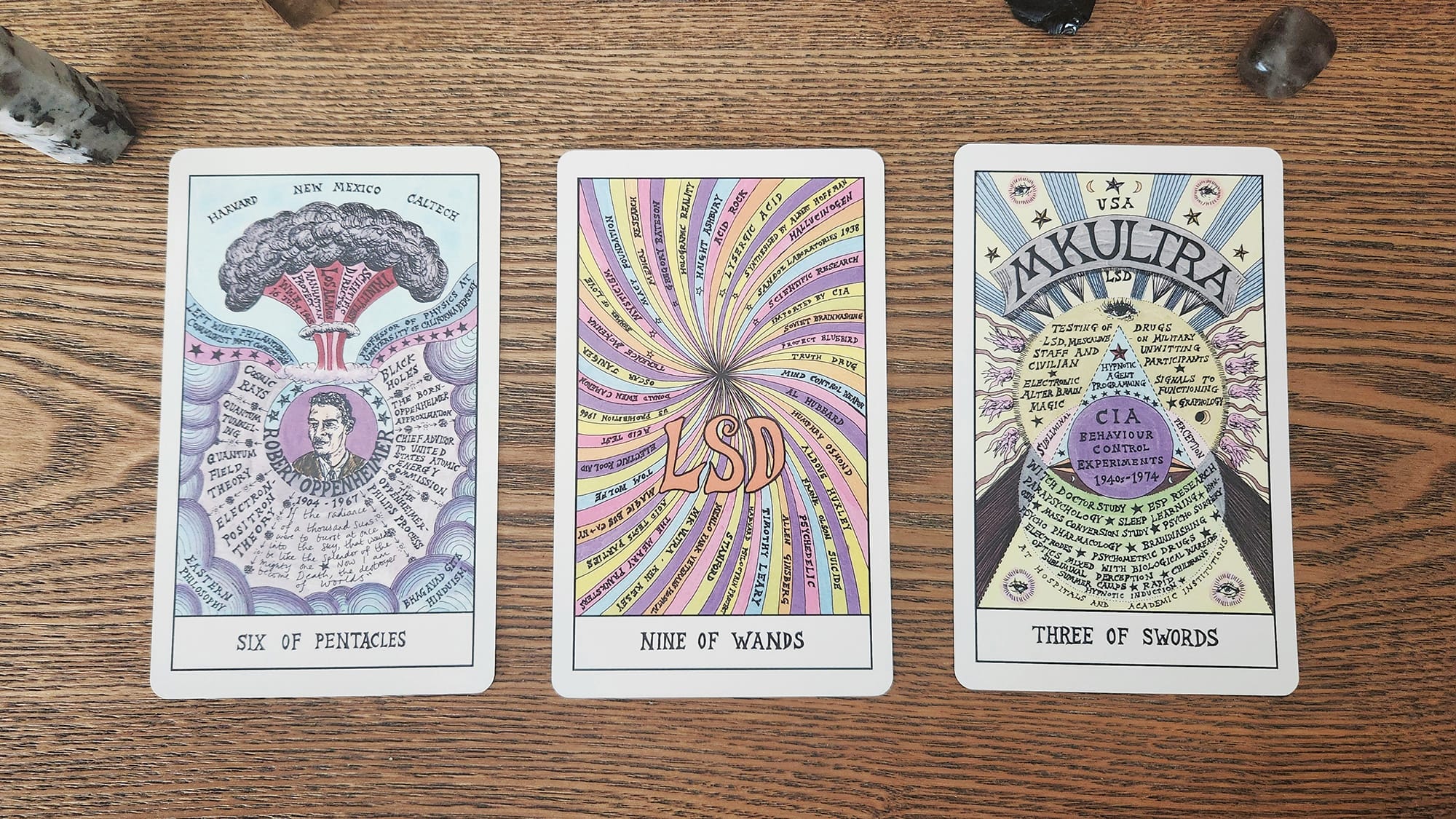
This concept might already exist among those who practice divination, or it might not. But I got the idea as I was figuring out what type of articles and other posts I wanted to offer my subscribers. Research articles are time-intensive, and personal essays are usually emotionally draining for me to write, so I wanted something that would be thematically connected to tech and feasible for me to write on a weekly basis. (Ironically, this article turned out to be the exact opposite of that.)
It just so happens I have a great tarot deck for this: HEXEN 2.0, which I used as a source for my Black Friday blog.
Based on actual events, people, histories and scientific projections of the future, and consisting of alchemical diagrams, a Tarot deck, photo-text works, a video and a website, HEXEN 2.0 offers a space where one may use the works as a tool to envision possible alternative futures (Treister, n.d.).
The deck uses Suzanne Treister's original artwork, which investigates the historical, interwoven parallels of government mass control programs and counterculture movements as they pertain to military imperatives, cybernetics, the internet, intelligence gathering, and how it all could be used to create "new systems of societal manipulation" (Treister, n.d.).
Specifically, it focuses on the Macy Conferences (1946-1953), a post-World War II "think tank" of anthropologists, ecologists, engineers, mathematicians, philosophers, psychiatrists, and sociologists sponsored by Josiah Macy Jr. Foundation in New York (which also footed the bill for Albert Einstein's first assistant (“Science: Einstein Assisted,” 1930).
Some of the conference participants helped build nuclear weapons, researched the psychological effects of LSD for the CIA's MKULTRA program, or outright rejected military funds for their work — but ultimately they all were responsible for developing and disseminating the concept of cybernetics, "the science of control and communication in the animal and the machine, in society and in individual human beings" (Treister, n.d.).
Saving the deep dive into their talks for another blog post, I'll just point out that HEXEN 2.0 was originally published as a book and tarot deck by Black Dog Publishing in 2012, the same year Treister's artwork started its exhibition tour at the Science Museum in London, England. If you can remember the biggest tech headlines from 13 years ago, 2012 was the year Facebook bought Instagram and went public, when Microsoft released Windows 8, and when the Israeli military started posting updates about its strikes on Gaza on Twitter (Kelly, 2013), among many other events.
Knowing the influences of Treister's work, I can't help but see HEXEN 2.0 as a cautionary tale, a premonition grounded in historical research (facts) that can help our society do the necessary shadow work to investigate our relationship with technology — and to ween ourselves of its influence as much as possible before it's too late.
A note about Tarot
I've practiced divination for several years now, and there are a few things I want to stress about it before I get into the first reading of this on-going series: Divination as a whole is an ancient spiritual practice and an important component of social and political history: Ancient Korean shamans shot divinatory arrows to reveal hidden knowledge for warlords; Ancient Greeks and Roman politicians gave their diviners private offices (Struck, 2016).
Tarot reading is much more modern by comparison, though many believe this card-based form of divination can be traced back to Tang Dynasty in China. "Legends say that the emperor's concubines entertained themselves by divining fortunes through these playing cards" (Wen, 2015). The 78-card deck we know today was born during the Italian Renaissance, around 1440. Divination and playing cards were banned at the time, but the church made an exception for tarot because it was popular among rich, elite society; unlike regular card games, tarot was regarded as a moral, intellectual pursuit. But as Wen notes, verifiable records linking tarot to the occult did not appear until the 1700s.
Today, tarot reading is still a form of spiritual practice that helps tap into the subconscious through symbolism and imagery, finding patterns and making connections between each card in a spread to your own life. Many neo-pagans and witches (like myself), as well as counselors, therapists, and life coaches use it. It's a misconception that tarot predicts the future. It does not. "Tarot helps with decision-making, irrespective of one's faith" (Wen, 2015). It provides insight, which can feel mystical if you are not used to sitting alone with your own thoughts.
The reading
I explore this question: What steps can I take to lessen my reliance on consumer technology?
This three-card spread is good for providing a general overview of a situation; the left card represents past influences on the present; the middle card represents the present situation; the right card represents the near future.
Because I am reading for a general audience, the message the cards provide may or may not resonate with you — and if it doesn't that's okay. If that's the case, the best thing to do is ask yourself why it doesn't.
One final note: I pulled these cards after I wrote the two sections above this one.
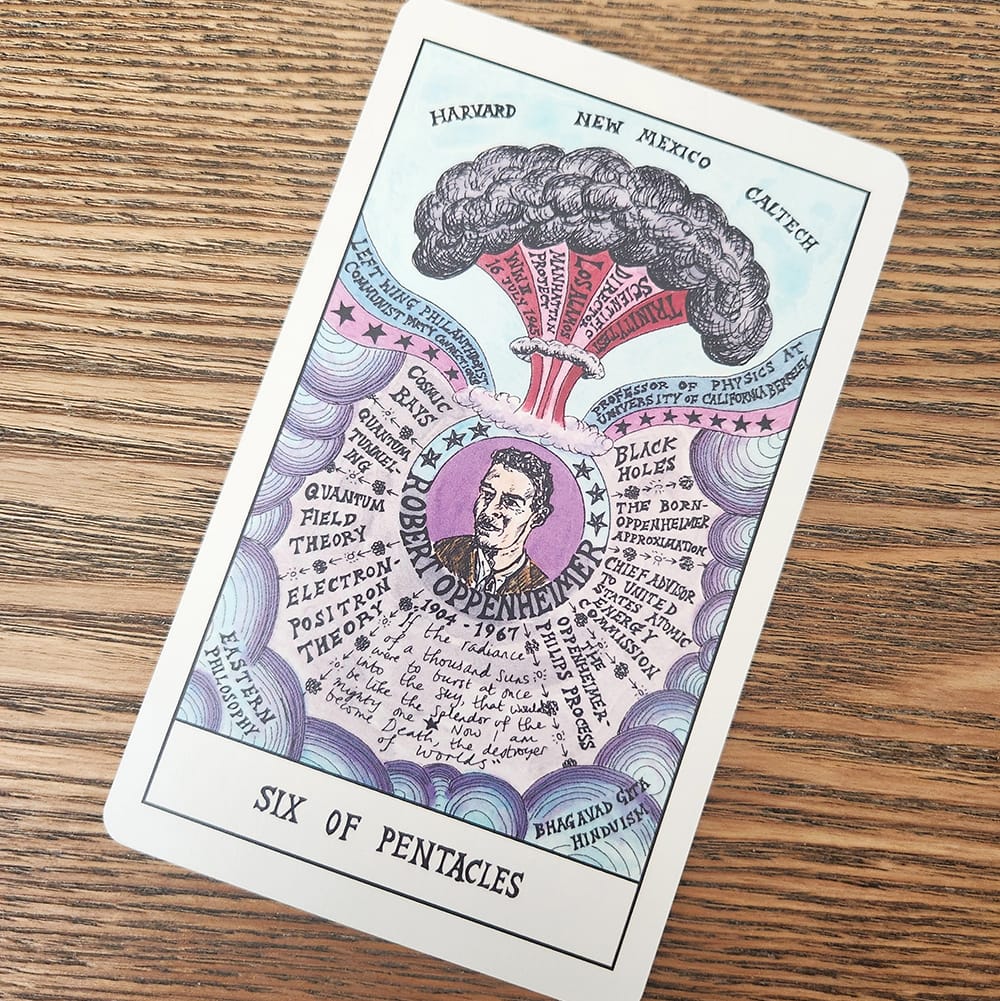
Past
Six of Pentacles (Robert Oppenheimer)
Starting with past events that continue to influence the present, we have the six of pentacles, represented by Robert Oppenheimer in the HEXEN 2.0 deck.
Pentacles represent the physical and material realm of humanity: foundations, finances, ambitions. Pentacles are also represented by the element of earth, how civilization manifests in the world. The number 6 is generally associated with harmony, in the body, mind, spirit, and home, but it can also signify responsibility and adjustment, perhaps to obtain harmony.
In the classic Rider-Waite tarot deck, the six of pentacles is about charity, generosity, and philanthropy — social justice. It depicts a well-dressed man holding a scale with two people dressed in rags kneeling at his feet. He gives coins to one person, but not the other, suggesting one is more worthy of charity than the other in the man's opinion — or that what is given doesn't meet the needs of both people. It's equal, but not equitable.
How in the hell does that relate to Oppenheimer, the director of the Manhattan Project? It's not a direct, one-to-one correlation, but I do think Oppenheimer is a perfect representation for the six of pentacles. I need to get into a bit of history to explain:
Hungarian physicist Leo Szilard helped Einstein draft a letter to President Roosevelt letting him know that Germany was working on atomic weapons (Einstein & Szilard, 1939). That send the US government into a paranoid frenzy, and thus the Manhattan Project was born. John von Neumann, a Hungarian-American and Macy Conference attendee, helped select the target sites for the bomb drop in Japan with digital computations (Treister, n.d.). He was also a founding figure in modern computing, the first to describe what eventually became known as a hard drive (John Von Neumann, n.d.).
Ultimately, Nazi Germany did not develop an atomic bomb during World War II. Neither did Japan. But the US did.
As we are (hopefully) well aware, the US's decision to literally decimate Hiroshima and Nagasaki resulted in so many deaths that no one has been able to determine a precise number (Wellerstein, 2024). Upon Oppenheimer's visit to Japan in 1960, he was quoted by a Japanese reporter, saying, "I do not think coming to Japan changed my sense of anguish about my part in this whole piece of history. Nor has it fully made me regret my responsibility for the technical success of the enterprise" (Kulacki, 2024).
"Responsibility for technical success" — Oppenheimer was in charge of a project to develop nuclear weapons before the Nazi's. It's possible he viewed his work as more than a paycheck — as charity and protection for humanity against communism and fascism. Through the lens of the six of pentacles, he wasn't literally giving people money. He was working to maintain whatever harmony and stability American's had left during war time, and that meant saving some people at the expense of others.
During his visit, Oppenheimer said the following to an elite gathering of Japanese scholars, artists, entrepreneurs, and officials:
"There is a lot of talk about getting rid of atomic bombs. I like that talk; but we must not fool ourselves. The world is not going to be the same, no matter what we do with atomic bombs, because the knowledge of how to make them cannot be exorcized. It is there; and all our arrangements for living in a new age must bear in mind its omnipresent virtual presence, and the fact that one cannot change that" (Kulacki, 2024).
Scientific discoveries are irreversible. Once the knowledge is there, it's there. There's no going back, and people will use it for good or evil — even in the name of charity.
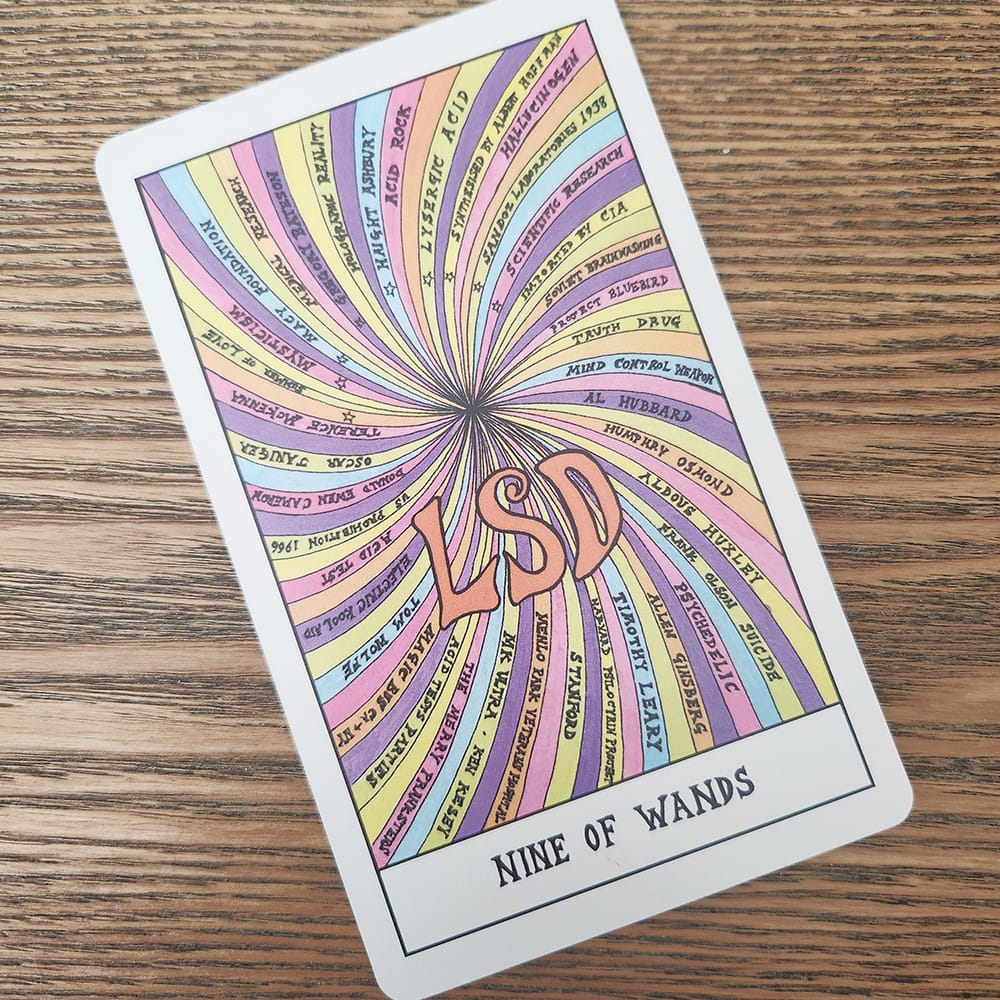
Present
Nine of Wands (LSD)
The same can be said about generative AI, smartphones, social media, and other consumer technology, so I don't think it's a coincidence that I pulled this card to represent our current "situationship."
Wands represent human ingenuity, creativity, and personal development and growth. "They correspond with the universal and collective willpower" (Wen, 2015). They can help answer questions related to our careers, as well as our overall health. Wands are also represented by the element of fire, which is symbolic of creation, transformation, purification — change. The number 9 also represents change, that change for the better is coming or that something is coming to completion. It may also signify an intense situation.
For the nine of wands, the Rider-Waite deck uses the image of a man clutching a tall staff (wand) tightly to his body. He stands at-the-ready, defensively, in front of a "fence" made up of eight more staffs. He's not seeking a confrontation, but is ready to fight for what is important to him. However, he stands alone against whatever incoming battle he expects to face. This card urges us not to be hyper-vigilant, to see enemies where there are none (like a bad LSD trip), and it reminds us that we can't fight big battles alone. We must seek help and be willing to help those asking for it. The nine of wands can also suggest resistance to change.
It's easy for me to draw a connection to LSD and generative AI with one word: hallucinations. But this card's representation of the present is so much more than that. As I mentioned earlier, LSD was used for the CIA's MKULTRA program, which I talk about more below, so here I want to focus on how LSD (the nine of wands) represents what I interpret as our present "come to Jesus" moment with technology.
The discovery of LSD's psychedelic effects was a total accident, but it became widely studied. In the 1950s, psychiatrists and psychologists were administering it to "cure neuroses and alcoholism and to enhance creativity" (Novak, 1997), even though it was only authorized for experimental use. In 1962, Dr. Sidney Cohen was the first to issue the medical community a warning about LSD, and in 1966 he testified before a congressional hearing; LSD was safe only if administered by a medical professional. In the wrong hands, or used frivolously, it was dangerous.
By that point, Cohen had studied LSD extensively. He first became interested in how it could treat mental illness while working as an assistant clinical professor at the Brentwood VA Hospital in 1953. "Early LSD researchers concluded that their subjects went through a temporary psychosis, most commonly categorized as schizophrenia or paranoia" (Novak, 1997), which Cohen concluded in his own survey based on that research at the time.
That wasn't his personal experience being high on LSD, though. In his book, "The Beyond Within: The LSD Story", he wrote:
"The problems and strivings, the worries and frustrations of everyday life vanished; in their place was a majestic, sunlit, heavenly inner quietude" (Cohen, 1965).
It seemed there was no logical reason for why some people had "good trips" and other had "bad trips," but Cohen was determined to figure out a way to ensure its effects were more positive than negative. With help from Betty Eisner, a recent UCLA doctorate in psychology, and an eclectic group of colleagues and friends like Alcoholics Anonymous founder Bill Wilson, writers Aldous Huxley and Gerald Heard, Canadian psychiatrist Humphry Osmond, and Al Hubbard, an eccentric entrepreneur who gave Huxley his first hit of LSD, Cohen accomplished that.
But afterward, a bunch of other LSD researchers started sharing the drug with their friends for recreational use. LSD social parties became popular. (Huxley hosted a bunch at his house.) The public became more aware of LSD, the media sensationalized it, delegitimizing its potential as a therapeutic drug. Cohen distanced himself from his friends and colleagues that had once helped him with his research, Eisner in particular. She started insisting some of their patients being treated with LSD were tapping into memories of past lives, and Cohen was not down with parapsychology.
Like the atomic bomb, LSD couldn't be put back in the lab, and consumer technology definitely can't go back to the silicon mines. It's too deeply ingrained in the everyday functions of our society and private lives, and not always in a good way. Social media algorithms can warp our sense of reality; smartphones can distract students in the classroom; LLMs routinely "hallucinate" information; countries use AI to decide where to drop their next bomb. It's no wonder so many of us probably feel like the nine of wands, fiercely defending what is rightfully ours. Our personal data. Our art. Our bodies. Our right to independent thought. Society is having a bad acid trip delivered through the screens of pocket computers 24/7.
Like the atomic bomb and LSD, all of this and more is currently being scrutinized because these technologies were introduced into society without regard as to what effect that would have on humanity. Or maybe they were introduced like the atomic bomb — with the full understanding of their destructive power. Either way, what was started in the Oppenheimer era has reached its climax.
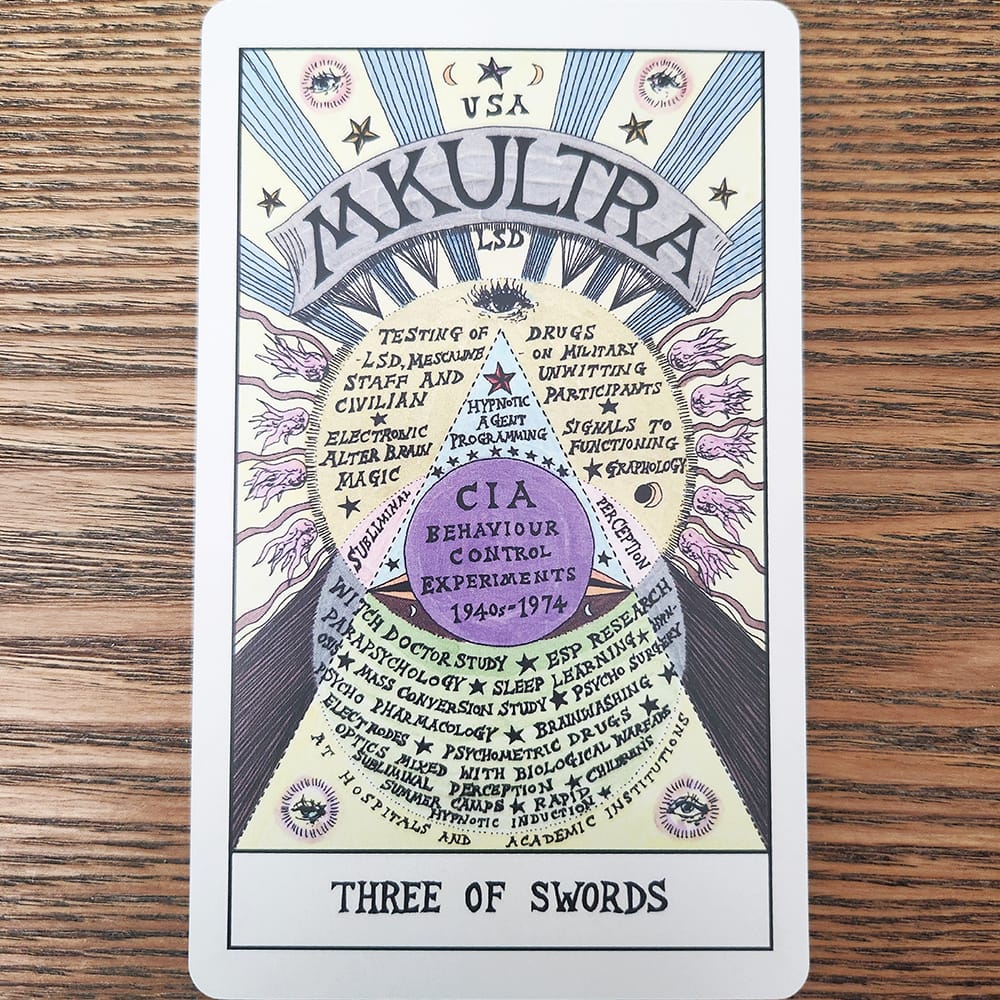
Future
Three of Swords (MKULTRA)
Okay, so that was a nice (long) history lesson, but what does all that have to do with lessening our reliance on consumer technology? You haven't said how we can do that! I know, I'm getting to that. I need to talk about MKULTRA first, but it will be the shortest history lesson — and before I do that, I need to explain the three of swords so I can neatly wrap this box up. (Reading is good for you.)
Swords represent intellect, communication, thoughts, ideologies, and the status quo as it relates to human ambition — and the consequences of that ambition. This suite is also represented by the element of air, which tends to pop up in readings that are based on a philosophical or psychological question. The number 3 also represents communication, as well as interaction, expression, and results — and if three 3 cards show up in a reading, deceit. (The past and present cards in this reading are both multiples of three.)
The Rider-Waite deck depicts this card with three swords piercing a bright red heart while a thunderstorm rages on in the background. This card represents heartbreak, strife, and loss channeled into anger. Betrayal. A hard "lesson related to ambitions, ideologies, and communication" (Wen, 2015) This card suggests that there is personal or political strife, vying for control, in the near future.
The CIA's MKULTRA experiments took place from the 1940s until 1974. Think about what was going on during that time: World War II, The Vietnam War, The Cold War, The Civil Rights Movement, Watergate, the moon landing, the first home televisions, the assassination of President Kennedy, the first computers — and that barely scratches the surface. (I left out all the serial killers.)
My point is that there was a simultaneous battle between maintaining the status quo and smashing it to pieces. McCarthyism, for instance, was a political witch hunt for alleged communists, to "burn" anyone who criticized American values. A similar push for social control has been happening for while. (Actually, it never stopped.) What I interpret the three of swords to mean here, for the future, is that we really need to start scrutinizing consumer technology as if it was part of MKULTRA.
We still don't know the exact number and type of mind control experiments the CIA carried out (the agency destroyed most of its MKULTRA records in 1973), but we do know the experiments focused on "pleasure, pain, hypnosis, drugs, sex, stage magic, refugees, and other elements of culture and nature seen as useful to the CIA’s efforts to interrogate or control the Other" (Price, 2016).
We also know that many of the social science and medical researchers had no idea the CIA was funding their research and for what purpose. They received grant money from foundations like the Human Ecology Fund that were actually fronts for the CIA. "Human Ecology lied to some anthropologists concerning the potential uses of their research" (Price, 2016). One grant in particular, Psychophysiological Analog Information by Digital Computer, was given to psychologist Herbert Zimmer between 1960 and 1963.
I don't know if Zimmer knew who was funding his research (I suspect he did), nor what his research specfically entailed, but based on this abstract from the American Psychological Foundation and this preview from The Annals of The New York Academy of Sciences (research done by other scientists, who reference Josiah Macy in their paper!), Zimmer was likely trying to figure out the the best way to collect data on a computer to show that certain biological responses correlate to specific emotional states. (When was the last time your smartwatch said you were stressed?) That would make sense considering he co-edited "The Manipulation of Human Behavior" with Albert Biderman, a reference book about "behavioral science contributions to interrogation techniques" (Sharav, 2015).
Knowing this bit of history, I see the three of swords emphasizing a few things: the continued influence of the past on the near future; feelings of isolation, heartbreak, and anger persist; knowledge is power; and while confronting the truth is often painful, it's necessary for growth.
About those steps...
What steps can I take to lessen my reliance on consumer technology?
Right now, diminishing tech's influence over your every day life probably feels impossible. This is the way our world operates, and we're not going back to a pre-digital society anytime soon, if we even can. For all the ugly ways the people in charge use or have used technology to shape society to their liking, there are plenty of people out there using it for good. They just don't make the headlines.
So, focus on what you can control: your money, your time, your thoughts. Research the fuck out of everything. Understand how something works and how it came into existence. Offer support. Ask for help. Get a library card and check out a book, and then read that book. Tell your spouse, partner, parent, friend, child you love them as they are in this moment. Choose to have more experiences that engage you with humanity. Challenge the status quo.
It will take effort. It will be inconvenient. It will be messy. It will piss people off. But it will be worth it.
Sources
Cohen, S. (1965). The Beyond Within: The LSD Story [Online]. Atheneum. https://archive.org/details/beyondwithinlsds0000cohe/page/n5/mode/2up
Einstein, A., & Szilard, L. (1939). Einstein–Szilard Letter. In FDR’s Papers as President; Selected Documents, 1939-1942. Franklin D. Roosevelt Presidential Library & Museum Digital Collections. Retrieved December 2, 2025, from http://www.fdrlibrary.marist.edu/_resources/images/atomic/atomic_02.pdf
John von Neumann. (n.d.). Nuclear Museum. Retrieved December 2, 2025, from https://ahf.nuclearmuseum.org/ahf/profile/john-von-neumann/
Kelly, H. (2013, January 4). The top 12 tech stories of 2012. CNN. https://www.cnn.com/2012/12/27/tech/web/top-tech-stories-2012
Kulacki, G. (2024, March 28). Oppenheimer’s second coming. Bulletin of the Atomic Scientists. Retrieved December 2, 2025, from https://thebulletin.org/2024/03/oppenheimers-second-coming/
Novak, S. J. (1997). LSD before Leary: Sidney Cohen’s Critique of 1950s Psychedelic Drug Research. Isis, 88(1), 87–110. http://www.jstor.org/stable/235827
Price, D. H. (2016). UNWITTING CIA ANTHROPOLOGIST COLLABORATORS: MK-Ultra, Human Ecology, and Buying a Piece of Anthropology. In Cold War Anthropology: The CIA, the Pentagon, and the Growth of Dual Use Anthropology (pp. 195–220). Duke University Press. https://doi.org/10.2307/jj.33610711.14
Science: Einstein assisted. (1930, October 27). Time. https://time.com/archive/6778588/science-einstein-assisted/
Sharav, V. (2015, March 26). 1961: The Manipulation of Human Behavior A Reference book. Alliance for Human Research Protection. Retrieved December 2, 2025, from https://ahrp.org/1961-the-manipulation-of-human-behavior-a-reference-book/
Struck, P. T. (2016). 2013 Arthur O. Lovejoy Lecture A Cognitive History of Divination in Ancient Greece. Journal of the History of Ideas, 77(1), 1–25. http://www.jstor.org/stable/43948771
Treister, S. (n.d.). HEXEN 2.0. Retrieved December 2, 2025, from https://www.suzannetreister.net/HEXEN2/HEXEN_2.html
Treister, S. (n.d.). HEXEN 2.0. Retrieved December 2, 2025, from https://www.suzannetreister.net/HEXEN2/Macy/MacyPortraits/Neumann.html
Wellerstein, A. (2024, August 30). Counting the dead at Hiroshima and Nagasaki. Bulletin of the Atomic Scientists. Retrieved December 2, 2025, from https://thebulletin.org/2020/08/counting-the-dead-at-hiroshima-and-nagasaki/
Wen, B. (2015). Holistic tarot: An Integrative Approach to Using Tarot for Personal Growth. North Atlantic Books.